LAND DEGRADATION IN KENYA
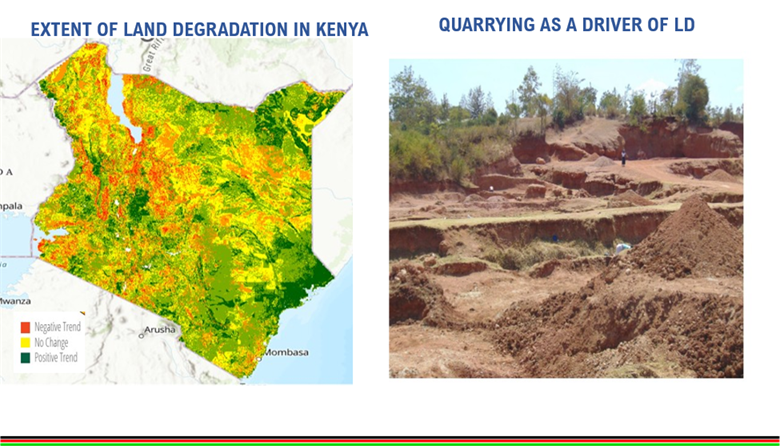
- THE EXTENT OF LAND DEGRADATION
A commonly cited estimate for Kenya is that about 20–30% of the country’s land area is degraded, based on assessments of declining land productivity, vegetation loss, soil degradation, and land-cover change. Kenya’s reporting under the land degradation neutrality framework found that roughly 21.6% of the country showed persistent productivity decline, with broader estimates placing total degraded land at around 25–30% of the national land area.
However, degradation is much more extensive in Kenya’s arid and semi-arid lands (ASALs), which cover about 80% of the country. Some studies have estimated that 30–40% of ASAL land is degraded.
Up to 50 per cent of rangelands are degraded, according to the Global Land Outlook Thematic Report on Rangelands and Pastoralists, launched by the UN Convention to Combat Desertification (UNCCD) in May 2024.
The trio UN Sister conventions (UNCBD, UNFCCC and UNCCD)- Address biodiversity loss, climate change adaptation & mitigation and Desertification and drought as drivers of Land Degradation.
Kenya’s population is projected to reach approximately 63.1 million by 2030, with an annual growth rate of about 1.87%. This equates to an annual increase of around 1.1 million people. The median age is expected to be 21.4 years, and the fertility rate is projected to be 2.92 children per woman.
Urbanization is anticipated to rise, with urban dwellers comprising 35.5% of the total population, amounting to approximately 22.4 million people. These projections are based on data from the United Nations Department of Economic and Social Affairs, Population Division.
To achieve SDG 15 which aims to “protect, restore and promote sustainable use of terrestrial ecosystems, sustainably manage forests, combat desertification, drought and floods and halt and reverse land degradation and halt biodiversity loss and strive to achieve a land degradation-neutral world” by 2030”.
Kenya’s population is projected to reach approximately 63.1 million by 2030, with an annual growth rate of about 1.87%. This equates to an annual increase of around 1.1 million people. The median age is expected to be 21.4 years, and the fertility rate is projected to be 2.92 children per woman.
Urbanization is anticipated to rise, with urban dwellers comprising 35.5% of the total population, amounting to approximately 22.4 million people. These projections are based on data from the United Nations Department of Economic and Social Affairs, Population Division.
- LAND DEGRADATION NEUTRALITY
Land Degradation Neutrality (LDN) is a globally adopted target that aims to halt the loss of healthy, productive land. Established by the UN Convention to Combat Desertification (UNCCD), it requires that the amount and quality of land resources needed to support ecosystems and enhance food security remain stable or increase over time.
Achieving LDN relies on a straightforward, balanced approach governed by three specific land-management actions:
Avoidance: Implementing sustainable land management practices to prevent the degradation of healthy areas before it happens.
Reduction: Minimizing the severity and spread of ongoing degradation.
Reversal: Actively restoring and rehabilitating already degraded lands.
- How Neutrality is Measured
Neutrality is essentially an environmental balancing act. If a parcel of land undergoes unavoidable degradation (e.g., urban expansion or deforestation), this loss must be offset by rehabilitating an equal or greater amount of degraded land within the same ecosystem or landscape.
- LAND DEGRADATION TARGETS
- Kenya’s three main Land Degradation Neutrality (LDN) targets are:
- Increase forest cover and restore degraded ecosystems: Expand Forest cover through afforestation, agroforestry, and restoration of forests, shrublands, grasslands, wetlands and croplands. Kenya aims to restore about 5.1 million hectares of land. Targeting 15 billion trees by 2030.
- Increase land productivity. Improve net land productivity in forests, shrublands/grasslands, and croplands that have experienced declining productivity by promoting sustainable land management practices. The target is to increase productivity by 16% in affected areas.
- Increase Soil Organic Carbon (SOC). Enhance soil health and fertility by increasing soil organic carbon stocks in croplands through sustainable land management practices. Kenya targets an increase of approximately 319,626 tonnes of soil organic carbon.
CHALLENGES
- Unsecure land rights are the biggest challenge in SLM approaches. Though Article 63 of COK 2010 defines three tenure regimes:1. Private land 2. Community Land and 3. Public land. In ASALs most of the land under community land rights is not titled. Titling confers ownership rights to the households and incentivizes them to invest and take care of it. Land grab is a major challenge in the ASAL counties.
- Policies developed are:
- National Spatial Plans, County Spatial Plans and National Land Use Plans, COK 2010, NCCAP 2022-2027, Land Reclamation Policy, etc.
- Improved livestock breeds that attain slaughter age at 2-3 years instead of 5-7 years results in reduced GHG that impact on the environment.
- Key Practices and Outcomes
1. Farmer Managed Natural Regeneration (FMNR)
- Farmers systematically selecting, pruning, and protecting naturally regenerating trees and shrubs on their farmlands.
- In Kenya’s Central Rift, FMNR interventions significantly increased food security from 42.6% to 73.6% and household income from 25.2% to 52.5% over three years
- It also led to measurable improvements in forest cover, tree density, canopy cover, soil fertility, water retention, and reduced erosion
- In Ghana, FMNR contributed to landscape-scale restoration over 10-15 years, improving organic matter and nutrient content, and providing diversified income streams through tree products.
2. Agroecology and Agroforestry
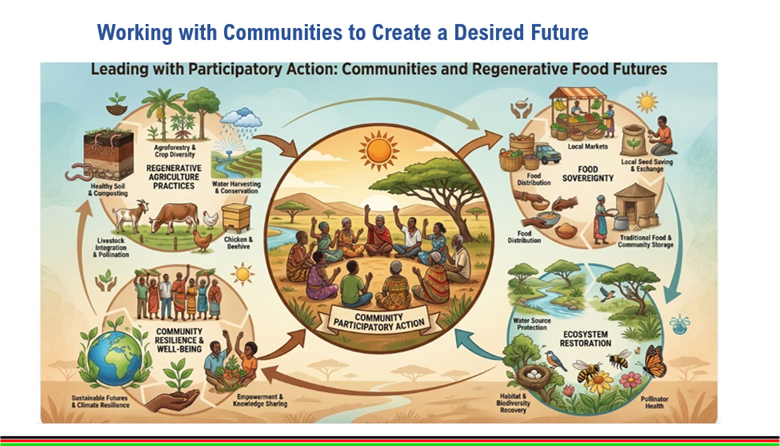
- Agroecology provides the scientific and practical framework for regenerative food systems, integrating ecological principles, traditional knowledge, and social justice
- Agroforestry, which integrates trees with crops and/or livestock, has shown significant ecological and productivity benefits across Africa
- For instance, in Uganda’s Taungya agroforestry system, vegetation cover increased from 0-25% to 51-75%, while participants cultivated diverse crops, contributing to food security and income.
Leave a Reply